








Bangladesh is taking its first step toward satellite-powered mobile connectivity, launching a pilot that could eventually allow users to send messages—and later make calls—even in areas where conventional cellular towers do not exist.
The Bangladesh Telecommunication Regulatory Commission (BTRC) has granted Banglalink permission to trial Direct-to-Cell (D2C) technology in partnership with Starlink, the satellite communications network operated by Elon Musk.
If successful, the initiative could help bridge one of Bangladesh’s longstanding connectivity gaps by extending mobile communication to remote hill tracts, coastal waters, and forest regions where building cellular infrastructure has proven economically difficult.
How Direct-to-Cell works
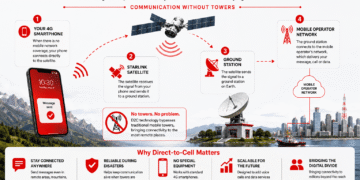
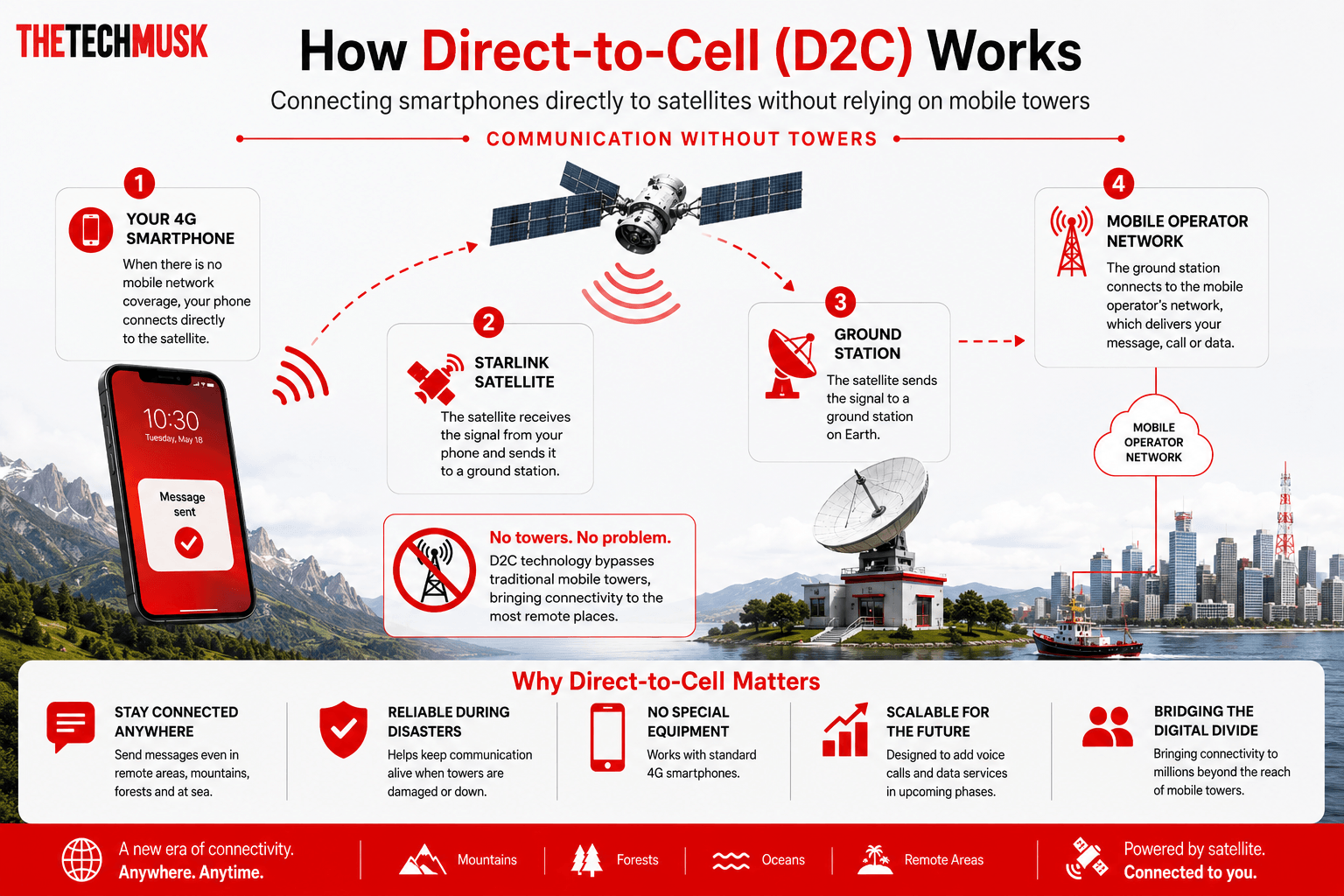
Unlike traditional mobile services, Direct-to-Cell technology enables compatible smartphones to connect directly to satellites when they fall outside the coverage of terrestrial cell towers.
Instead of routing traffic through the nearest base station, the phone communicates with a low-Earth orbit satellite, which relays the signal to a ground station before connecting it to the user’s mobile operator.
One of the technology’s biggest advantages is that it does not require specialized satellite phones. According to industry experts, standard 4G smartphones can access the service once compatible satellite infrastructure is available.

Initially, the pilot supports SMS and over-the-top (OTT) messaging, while voice calling and mobile data services are expected to be introduced in later phases, subject to technical and regulatory approvals.
Closing Bangladesh’s connectivity gaps
Although Bangladesh has nearly 190 million mobile subscriptions and more than 120 million mobile internet users, network availability remains inconsistent across difficult terrain.
According to BTRC data, the country’s mobile operators operate more than 21,000 towers, with an additional 7,000 shared tower sites. Yet large portions of the Chittagong Hill Tracts, the Sundarbans, offshore fishing zones, and remote river islands continue to experience unreliable or nonexistent coverage.
The challenge is largely economic.
Deploying towers in sparsely populated or geographically difficult locations often generates limited commercial returns, reducing incentives for operators to expand coverage.
The issue recently drew public attention after a school teacher in Rangamati reportedly climbed a tree to obtain sufficient mobile signal to submit official documents online—an incident that highlighted persistent connectivity challenges in rural Bangladesh.
Emergency communications could become a key use case
Industry observers believe satellite-to-mobile connectivity could become particularly valuable during natural disasters.
Bangladesh frequently faces cyclones, floods, and other emergencies that can damage terrestrial telecommunications infrastructure. A satellite-based communication layer could help maintain emergency messaging when traditional networks become unavailable.
Banglalink says early results from the pilot have been encouraging.
According to Taimur Rahman, the operator’s Chief Corporate and Regulatory Affairs Officer, commercial deployment would begin with text messaging before expanding to voice and data services in later phases.
Telecommunications expert Sumon Ahmed Sabir also noted that once Starlink’s next-generation satellite constellation becomes fully operational, users in remote forests, mountainous regions, and offshore waters could eventually place voice calls without relying on nearby cell towers.
Bangladesh joins a growing regional trend
Bangladesh’s trial comes as satellite-to-mobile technology gains momentum across Asia.
In the Philippines, Globe Telecom recently launched commercial Direct-to-Cell services in partnership with Starlink after receiving regulatory approval. According to industry publication Light Reading, the service was used to support communications following a major earthquake in Mindanao.
Market research firm Fortune Business Insights also forecasts that the Asia-Pacific region will become the fastest-growing market for Direct-to-Cell services in 2026.
Commercial rollout still depends on global regulation
Despite the positive early results, Bangladesh’s pilot does not guarantee commercial approval.
BTRC Chairman Emdad-ul-Bari said international regulatory discussions remain ongoing over whether spectrum currently designated for terrestrial mobile services can also support satellite-based communications.
The issue is expected to be addressed at the International Telecommunication Union‘s World Radiocommunication Conference 2027 (WRC-27).
Until global spectrum rules are finalized, Bangladesh’s Direct-to-Cell initiative will remain an experimental deployment rather than a commercially approved nationwide service.
Why it matters
Direct-to-Cell technology represents a significant shift in mobile communications. Instead of extending connectivity by building more towers, operators can use low-Earth orbit satellite networks to eliminate coverage gaps for compatible smartphones.
For countries like Bangladesh—with vast coastal areas, mountainous terrain, and disaster-prone regions—the technology could offer a practical way to expand mobile access where traditional infrastructure remains difficult or uneconomical to deploy.