









The enterprise AI conversation may be moving past pilots faster than expected — but production deployment is proving far messier than the industry narrative suggests.
New research from Sinch found that while a majority of enterprises already have AI-powered customer communications agents running in production, many are struggling to keep them there.

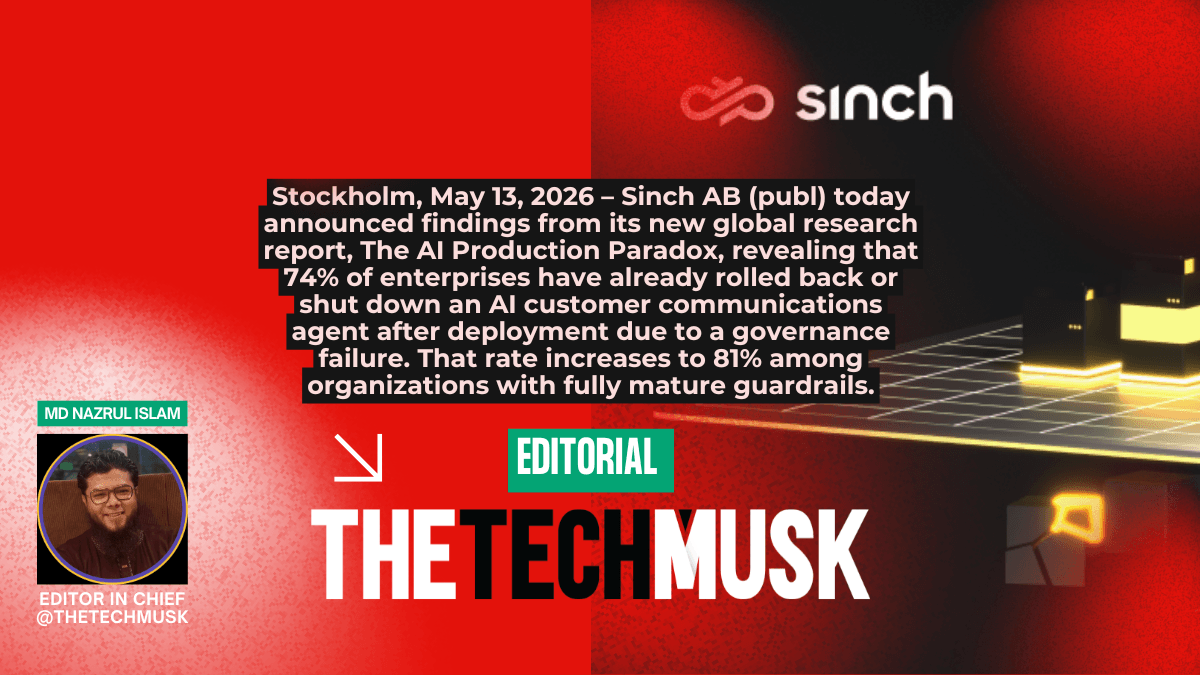
According to Sinch’s new report, The AI Production Paradox, 74% of enterprises have rolled back or shut down a live AI customer communications agent after deployment due to governance failures. Among organizations with what Sinch describes as mature governance frameworks, the rollback rate rises to 81%.
The findings are based on a survey of 2,527 senior decision-makers across 10 countries and six industries conducted between January and February 2026.
AI deployment is no longer the bottleneck
The report challenges the widely repeated assumption that enterprises remain stuck in experimental AI phases.
Instead, Sinch says 62% of enterprises already have AI communications agents live in production, particularly across messaging, voice, and customer engagement environments.
The bigger issue now appears to be maintaining reliability, performance, and control once those systems are deployed at scale.
“The industry has assumed that better governance leads to better outcomes,” said Daniel Morris, Chief Product Officer at Sinch. “But that’s not enough.”
According to Morris, engineering teams are spending significant time building internal safety and governance layers around AI systems rather than improving customer experience itself — a burden he describes as a “guardrail tax.”
Governance maturity may expose more failures, not fewer
One of the more counterintuitive findings in the report is that organizations with the most mature governance systems reported the highest rollback rates.
Sinch argues this does not necessarily indicate weaker AI performance. Instead, mature organizations may simply be detecting failures earlier due to better monitoring and operational visibility.
The report found:
- 84% of AI engineering teams spend at least half their time on safety infrastructure
- Enterprises invest more heavily in trust, security, and compliance (76%) than in AI development itself (63%)
- 98% of organizations plan to increase AI investment in 2026
The findings suggest that governance spending alone is not solving production AI reliability challenges.
Infrastructure becomes the hidden differentiator
Perhaps the report’s strongest conclusion is that communications infrastructure quality may matter more than governance maturity itself.
Sinch says satisfaction with the underlying communications infrastructure emerged as the strongest predictor of successful AI deployment, outperforming both governance investment and AI spending levels.
That has implications for vendors operating in CPaaS, UCaaS, and enterprise communications infrastructure markets, where AI systems increasingly rely on real-time orchestration across messaging, voice, email, and customer context layers.
The report found:
- 87% of organizations consider high-performance infrastructure essential or very important
- 55% are building custom infrastructure to manage cross-channel AI context
- 86% have evaluated or are actively considering new communications providers
The next AI challenge: operational resilience
The broader takeaway from the research is that enterprise AI is entering a new phase — one where the challenge is less about deploying models and more about operating them safely, reliably, and continuously in customer-facing environments.
As enterprises move AI deeper into communications workflows, infrastructure resilience, observability, and governance may become just as important as the models themselves.
The result is a growing realization across the industry: getting AI into production was only the beginning.