









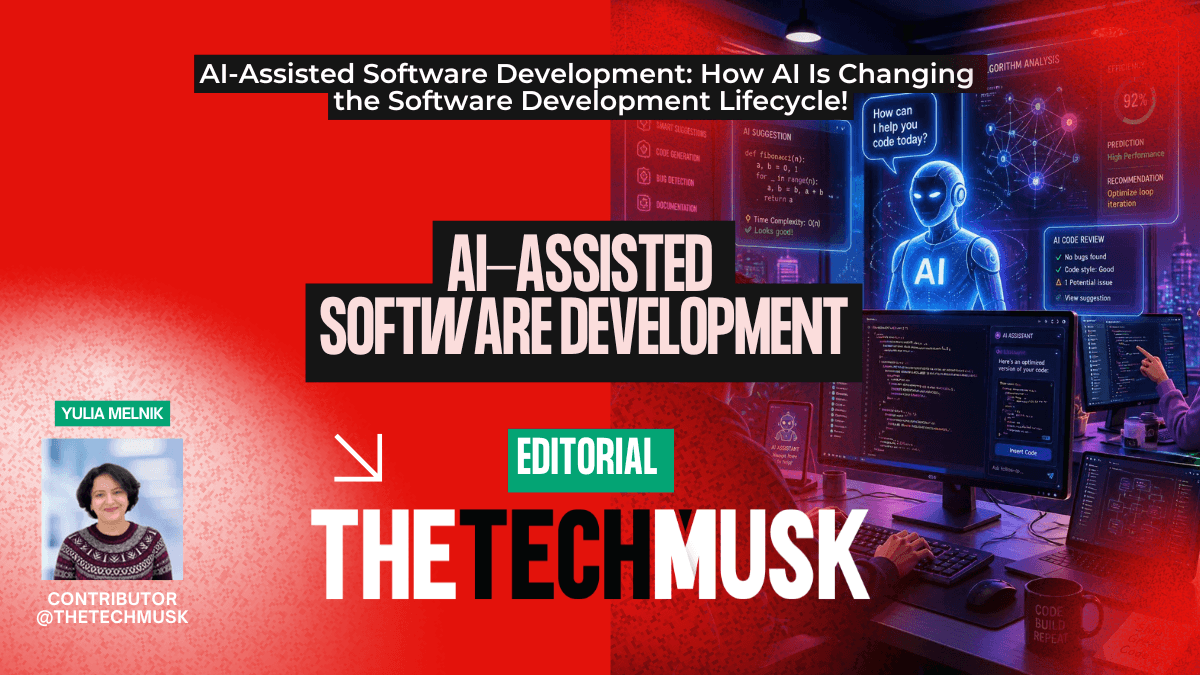
Artificial Intelligence has emerged as an integral component of software development. It began with basic code completion and has transformed into tools that aid in planning, programming, testing, deploying, and maintaining applications.
AI is not considered a threat to the software engineering profession. On the contrary, it is changing the work of software developers and automating repetitive activities, which allows teams to come to a decision faster and make better decisions.
What Is AI-Assisted Software Development?
AI-enabled software development brings together both human experience and artificial intelligence-powered systems.
This is how artificial intelligence can help in the process throughout the whole software development life cycle. In particular, actual AI systems can assist programmers in the following:
- help with code creation and interpretation;
- help with testing and documenting;
- help with gathering software requirements;
- help with code evaluation;
- help with bug discovery and safety problems;
- help with log estimation and failure investigation;
- help with reengineering and preserving current information technology solutions.
How AI Is Changing the Development Lifecycle
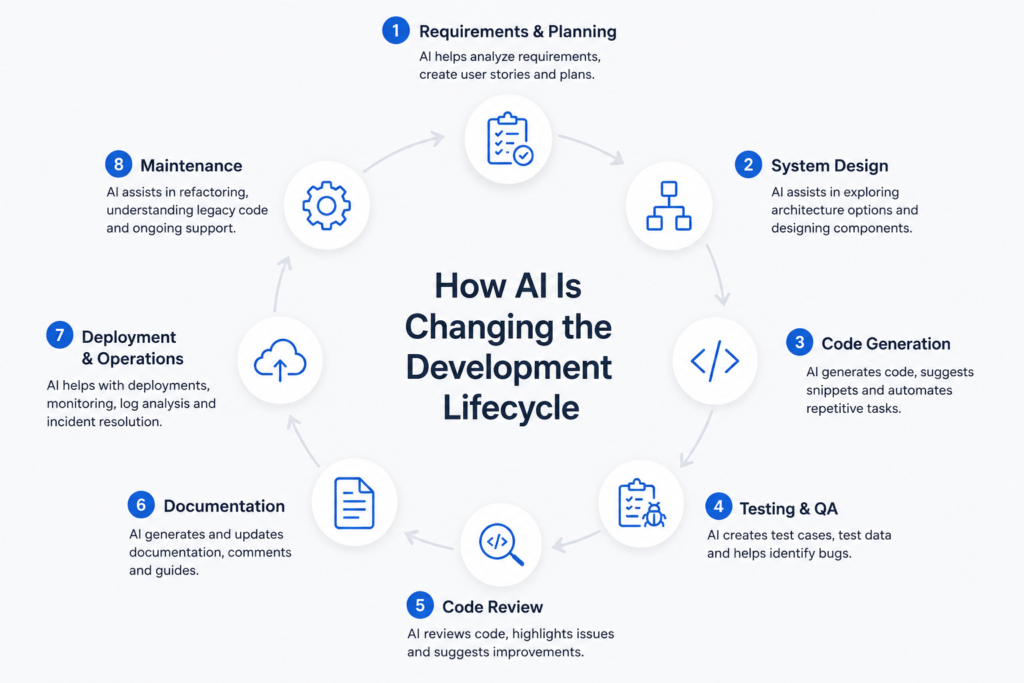
With the support of an AI-assisted development partner, artificial intelligence is now involved in nearly all phases of software development.

1. Planning and Requirements
AI simplifies early-stage information for better project organization.
For example, it can convert meeting notes and other materials into user stories, acceptance criteria, technical tasks, and other details.
Thus, it makes it easier for teams to organize their ideas and find any missing information at an early stage. However, stakeholders still need to confirm the final requirements.
2. System Design
AI can assist teams in evaluating various technical options before the development process even starts.
AI is capable of making comparisons between the different types of architectures, proposing required components of the system, preparing the diagram of the data flow, and preparing documentation of the technical decision.
While AI may be helpful for assessing the other available options, the development of the system has to be supervised by human experts, as AI may lack understanding of the goals of the company, budgets, and limitations of the existing infrastructure.
3. Generation of Code
The use of Artificial Intelligence can lead to fast-tracking of the implementation process by performing repetitive development tasks.
Professionals can rely on this technology in creating functions, API, queries within databases, configuration, and components of applications that are repetitive.
Artificial Intelligence works very efficiently when it comes to preparing boilerplate and template patterns of implementation. Nonetheless, the code generated by AI may still contain errors and other issues.
4. Legacy Code and Onboarding
Artificial Intelligence can turn highly complex and unknown codebases into simpler ones.
AI is capable of explaining different code lines, making a summary of code modules, identifying dependencies, and showing where the changes can have an effect on the entire system.
Due to that, AI tools can help software developers to learn large codebases faster than before. However, it is vital to note that AI can give only partial explanations when it does not have access to the complete repository or production environment.
5. Quality Assurance and Testing
AI constitutes an improvement in the creation and management of tests.
With AI, it is possible to develop unit tests, integration tests, test data, modeling, and corner cases.
The review of tests created with the help of AI is also necessary because AI tests can repeat mistakes made in the code they are testing.
6. Code Review
Artificial intelligence facilitates the provision of an extra layer of supervision prior to approval of any change.
AI assists in summarizing pull requests and identifying repetitive logic, as well as missing validations and improvement recommendations.
AI gives the best result as an assistant in the reviewing process; however, it does not substitute for peer review since human evaluators are still necessary for assessing business logic, system-wide impact, and maintainability.
7. Documentation
By utilizing AI, groups can maintain their technical information in a manner that is clear and up to date.
This ensures the preparation of many types of documentation, including API documentation, installation manuals, release notes, and others.
While generating documentation with the help of AI minimizes the workload for the teams, the generated materials need to fully correspond to the existing system.
8. Deployment and Maintenance
AI plays a significant role in the deployment and maintenance aspects of software delivery and operations.
It assists in building CI/CD pipelines, infrastructure templates, scripts for deployment, and monitoring regulations. Moreover, it can be used to study logs and troubleshoot failures and incidents.
The impact of mistakes in infrastructure and production implementation means that recommendations made by AI systems must be treated with utmost caution and subject to thorough testing and validation.
Benefits of AI-Assisted Development
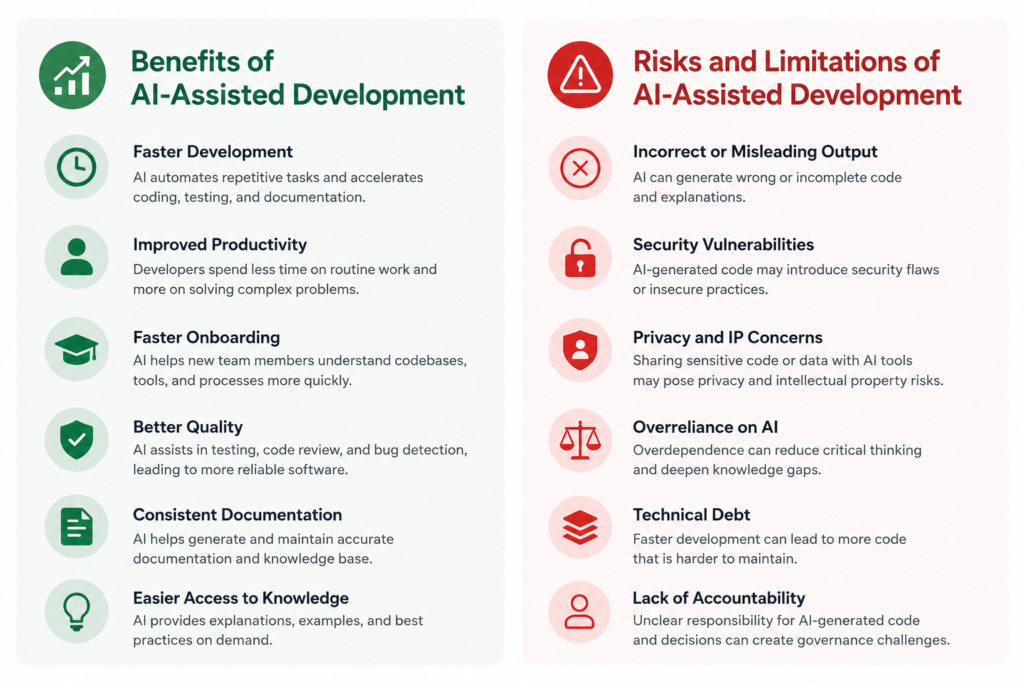
AI brings many advantages, mainly faster development and the elimination of repetitive tasks.
Here’s what AI offers:
- Faster prototyping and development.
- Fewer repetitive tasks.
- Faster onboarding.
- Improved testing and documentation.
- Easier access to technical knowledge.
- More time for thinking and solving problems.
Risks and Limitations
However, AI poses some risks that need to be managed properly.
Among the most common problems are:
- Incorrect or fake results.
- Security risks.
- Privacy and intellectual property concerns.
- Overreliance on AI code.
- More technical debt.
- Less understanding of the system.
- Ambiguity regarding responsibility for AI-made changes.
Best Practices
Adopting AI successfully depends on having concrete guidelines and robust engineering processes.
Any code constructed by artificial intelligence should go through the same reviewing, testing, and security procedures as any human-written code. Teams should make use of properly approved tools, safeguard sensitive information, and start working on low-risk jobs like writing documentation, generating tests, and explaining the code.
The measure of AI introductions should also not only look at the amount of code generated but the speed of delivery, defects, security issues discovered, review efforts, and developer satisfaction.
Conclusion
Artificial Intelligence isn’t just a hype; it is transforming every phase of the software development lifecycle, including requirement gathering/architecture, testing, deployment, and maintenance.
Its pros are speed, automation, and access to information, but the cons are related to inaccurate results, insufficient control, and too much trust in machines.
The successful groups will treat AI as a collaborator in the process of development, instead of an autonomously functioning assistant.