











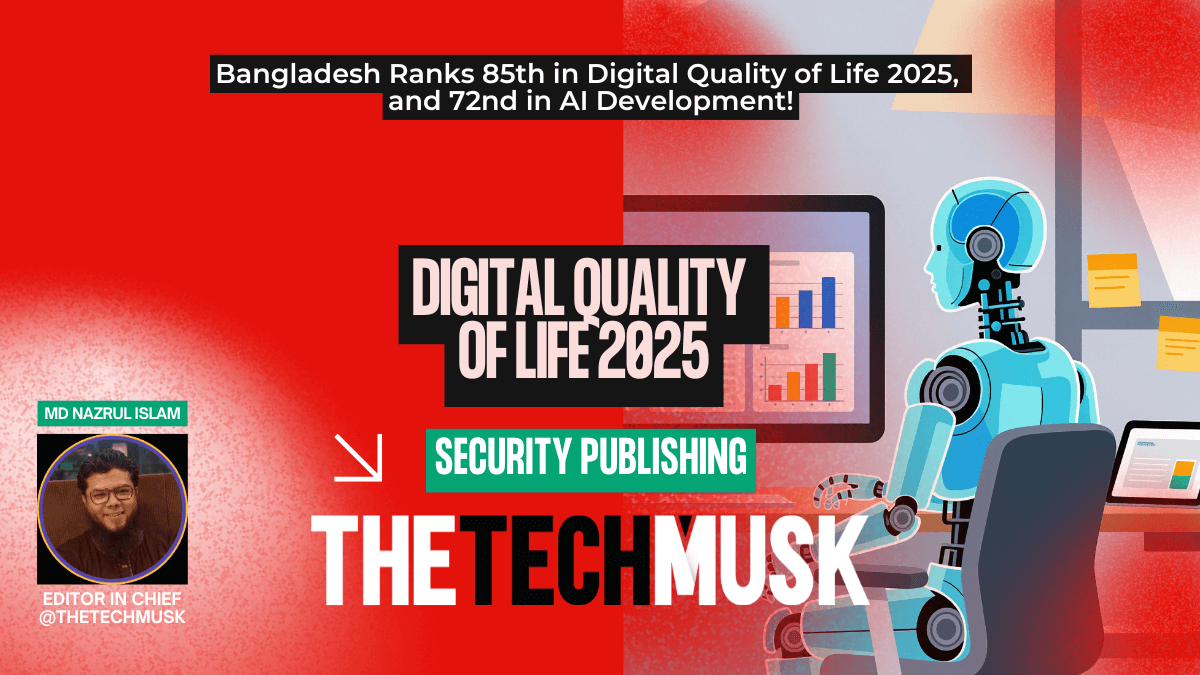
The seventh edition of Surfshark’s Digital Quality of Life Index (DQL) 2025 ranks Bangladesh 85th globally (previously 83rd). The study assesses countries’ overall digital well-being across five areas: internet affordability, internet quality, digital infrastructure, digital security, and artificial intelligence. Bangladesh lags behind India (62nd), but outperforms Pakistan (105th). Finland tops the index, while the US leads the artificial intelligence pillar despite ranking 16th overall.
Bangladesh performed best in internet quality, claiming 52nd place, but faced challenges in digital infrastructure, ranking 103rd. The nation ranks 65th in internet affordability, 71st in digital security, and 72nd in artificial intelligence — a newly introduced pillar in this year’s edition.
“Measuring digital quality of life is no longer possible without looking at AI implementation, which is why we made AI one of the core pillars of our global benchmark report. It shows whether a country is attractive to AI investments and ready to integrate the technology into public services. Higher positioning in AI development can streamline routine work, create new job positions, enhance public services, and support sustainable economic growth,”
– says Tomas Stamulis, Chief Security Officer at Surfshark.
“Since AI is here to stay, all countries should start prioritizing reliable nationwide connectivity,“ he adds. “That includes modernizing and securing IT systems, training and reskilling their workforce, and adopting clear laws with effective oversight. However, what is concerning is that even some of the highest‑ranked countries in AI development still lack strong data protection laws, which is essential when processing large volumes of sensitive information.”
Bangladesh ranks lower in artificial intelligence than 59% of the countries analyzed, with 71 countries above.
Bangladesh is 71st in the world in digital security — eleven places lower than last year
Digital security measures how safe people are online. Bangladesh is unprepared to fight against cybercrime; the country has some data protection laws. Bangladesh lags behind India, which ranks 63rd, but outperforms Pakistan (107th) in the digital security pillar.

Bangladesh’s internet quality is higher than the global average, ranking 52nd globally
- Bangladesh’s fixed internet averages 81Mbps. However, the world’s fastest fixed internet — Singapore’s — is 463Mbps.
- Bangladesh’s mobile internet averages 43Mbps. The fastest mobile internet — the UAE’s — is 576Mbps.
Compared to India, Bangladesh’s mobile internet is 75% slower, while fixed internet is 15% slower. Since last year, mobile internet speed in Bangladesh has improved by 44%, while fixed internet speed has grown by 29%.
Bangladesh’s internet affordability is just around the global average
Bangladeshis have to work about 3 hours 40 minutes a month to afford fixed internet. While this is less than average, it is 19 times more than in Bulgaria, which has the world’s most affordable fixed internet (Bulgarians have to work 11 minutes and 26 seconds a month to afford it).
Bangladeshis have to work about 1 hour 1 minute a month to afford mobile internet. This is 8 times more than in Angola, which has the world’s most affordable mobile internet (Angolans have to work 7 minutes and 27 seconds a month to afford it).
Bangladesh still struggles in digital infrastructure
Advanced digital infrastructure makes it easy for people to use the internet for daily life, from working and studying to shopping. This part of the study looks at both how many people have internet access and how ready a country is to make the most of digital technologies. In Bangladesh, 45% of people have internet access, ranking 105th in the world, while the country ranks 86th for network readiness.
“Artificial intelligence can transform economies and improve quality of life,” says T. Stamulis. “But without investment in digital infrastructure and ensuring society is ready to use these tools, AI risks widening the digital divide, leaving some countries and vulnerable populations behind.”
Europe still leads overall digital wellbeing, but lags in AI development
Finland tops the global digital quality of life ranking, followed by Germany, Denmark, Switzerland, and France. Europe accounts for nine of the top ten countries, though, unlike in 2024, Singapore has joined the top ten this year. In AI development, the United States is in the lead, followed by Singapore and South Korea. Europe has four countries in the top rankings: the United Kingdom, France, Germany, and the Netherlands.
Access Bangladesh’s full profile and interactive comparisons:
https://surfshark.com/research/dql/country/BD
This Digital Quality of Life Index 2025 examines 121 countries, using open-source data from the United Nations, the World Bank, and other reputable sources. The index evaluates five pillars: internet quality, internet affordability, digital security, digital infrastructure, and artificial intelligence, which has been added as a new pillar in 2025.