










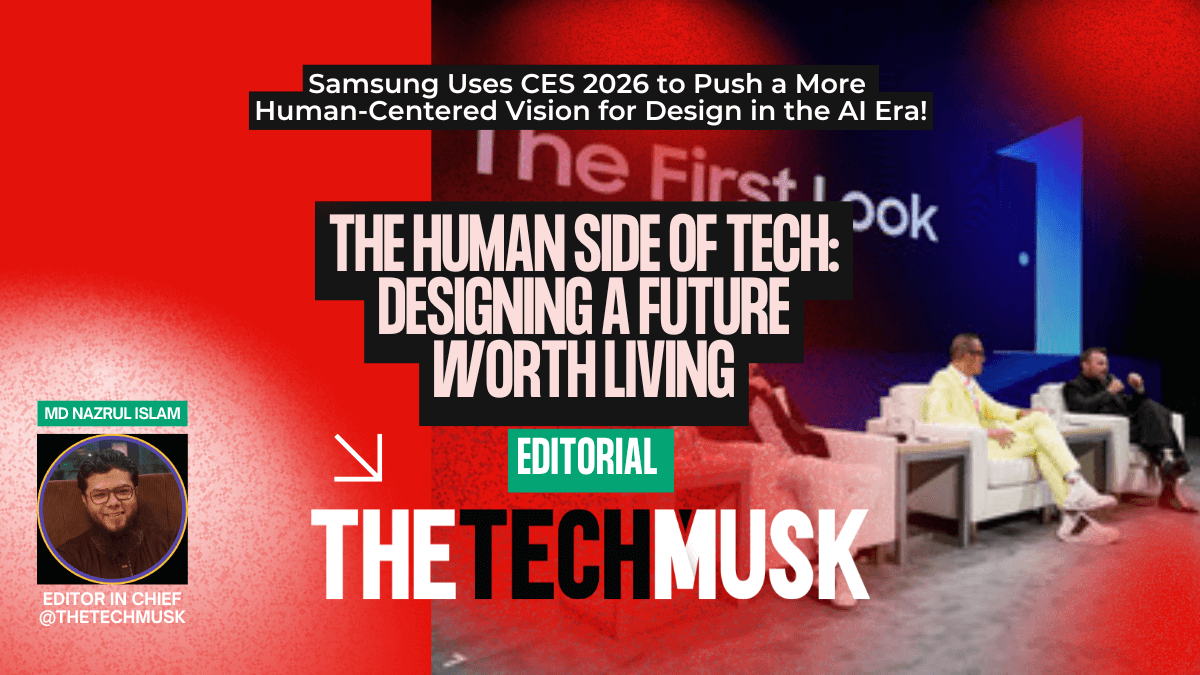
Samsung closed out its CES 2026 Tech Forum series in Las Vegas with a message that stood apart from the usual processor counts and product demos: the future of technology, it argues, should feel more human.
The final session, titled “The Human Side of Tech: Designing a Future Worth Living,” was held at Samsung’s The First Look space at The Wynn and brought together Samsung Chief Design Officer Mauro Porcini, designers Karim Rashid and Fabio Novembre, and moderator Debbie Millman, host of the Design Matters podcast.
Moving beyond tech minimalism
For the past two decades, minimalism has dominated the visual and experiential language of consumer technology. The panel questioned whether that uniformity still serves users in an era increasingly shaped by AI.

Millman framed the challenge bluntly: tech design has become unusually homogeneous compared to other creative industries. The question, she suggested, is what happens when technology moves beyond specifications and efficiency and begins to reflect emotion, warmth, and individuality.
Samsung’s answer, according to Porcini, lies in shifting design from a product-first mindset to one that prioritizes how technology fits into people’s lives, routines, and emotional needs — especially as technical barriers to building new products continue to fall.
Design as a people-first discipline
Throughout the session, panelists emphasized design as a fundamentally human act — one that makes care, intention, and values visible in everyday objects.
Porcini outlined Samsung’s broader design purpose as enriching quality of life through technology designed for humanity, a philosophy he said is focused on helping people “live longer, live better, live louder, and live on” through tools that support wellbeing, creativity, and self-expression.
Rashid echoed that sentiment, arguing that design enables emotional connections with objects that go far beyond utility. When done well, he said, products become part of personal identity rather than interchangeable tools.
AI guided by human values
AI was a central theme of the discussion, but not as a replacement for human creativity. Instead, panelists framed AI as most powerful when shaped by human values.
Porcini described Samsung’s design philosophy as “AI × (EI + HI)” — artificial intelligence amplified by emotional intelligence and human imagination. In his view, AI should both be designed through human empathy and, once in use, help amplify it.
“Do not fear technology,” Porcini said during the session. “We are here to humanize it, guide it, and shape it.”
The panel broadly agreed that AI’s long-term impact will depend less on raw capability and more on how thoughtfully it is integrated into human experience.
From objects to experiences
The conversation ultimately pointed to a broader shift underway in consumer tech: from designing devices to designing experiences. Expressive design, the panelists argued, plays a critical role in creating technology that invites connection, supports self-expression, and feels emotionally resonant.
Fabio Novembre summed it up succinctly: “Happiness is the aim of design.” Rather than fading into the background, he argued, design should reclaim a central role in shaping how people relate to technology.
For Samsung, the CES 2026 forum served as a statement of intent. As AI becomes embedded across its product portfolio, the company is signaling that differentiation won’t come from intelligence alone — but from how human that intelligence feels.