










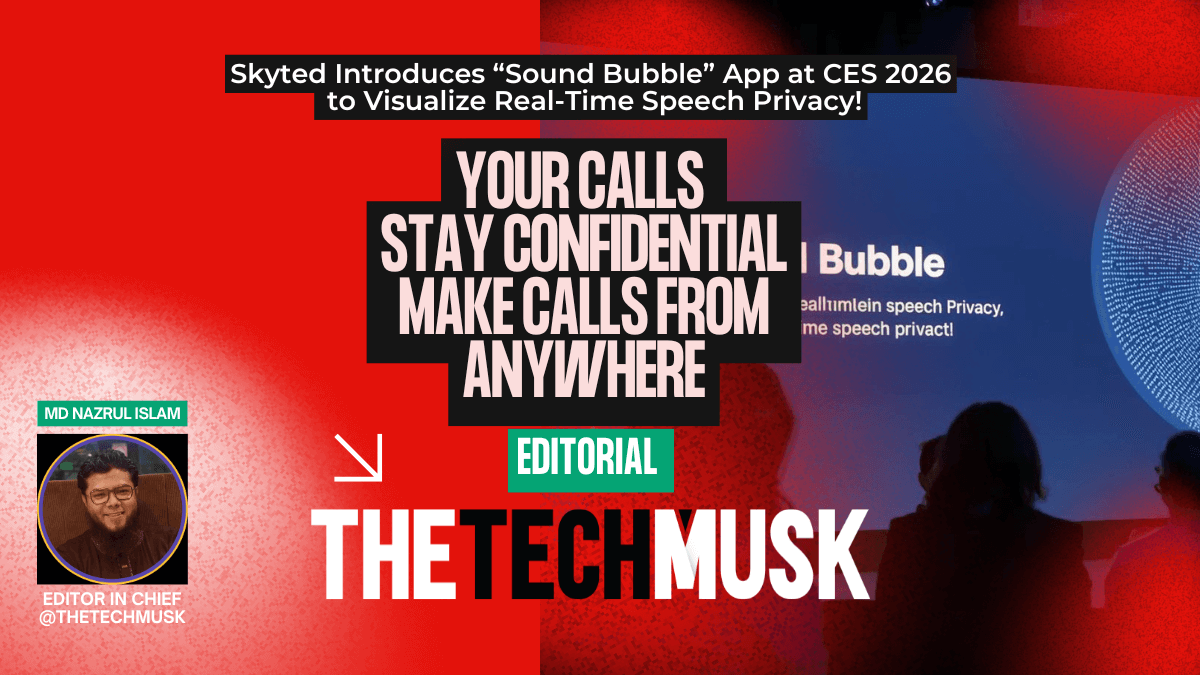
French startup Skyted is heading to CES 2026 with a new software layer designed to make private conversations in public more predictable — and more controllable.
The company will unveil Sound Bubble, a companion app for its Skyted 320 headset, that visually shows users how far their voice can be understood by people nearby. The goal is to give users real-time feedback on speech privacy while taking calls in shared spaces like trains, airplanes, cafés, or open offices.
Turning voice privacy into something visible
Sound Bubble works by providing live visual indicators that reflect how far a user’s voice carries based on speaking volume and environment. As users adjust their voice, the app shows whether their speech remains private to someone sitting next to them, effectively turning an abstract concept — “Am I being overheard?” — into a measurable signal.
Behind the scenes, the Skyted 320 headset continuously adapts the user’s voice so it stays clear and intelligible for the person on the call, while remaining imperceptible to people nearby, even when the user speaks softly.

Software strengthens Skyted’s hardware play
The Sound Bubble app builds on the Skyted 320 headset, which the company positions as the first headset designed specifically for truly private conversations in public spaces. The device has already been showcased at events including CES Las Vegas, Mobile World Congress, and VivaTech 2025, where Skyted has been pitching a new category of “silent communication” hardware.
With Sound Bubble, Skyted is extending that pitch beyond hardware, adding a software experience that helps users understand — and trust — what the headset is doing in real time.
CES 2026 demo plans
Skyted will demo Sound Bubble and the Skyted 320 headset at CES Unveiled and at Eureka Park in the Venetian Hotel during CES 2026, where attendees can test the system live.
Founded in 2021 by former Airbus executive Stéphane Hersen, Skyted focuses on acoustic technologies for secure and confidential communication. The company is backed by Airbus Développement, the European Space Agency, and ONERA, signaling strong institutional support for its approach to voice privacy.
As hybrid work, mobile productivity, and always-on calls continue to blur the line between private and public spaces, Skyted is betting that making speech privacy visible could be as important as improving audio quality itself.